eSense Is Betting That Sexual Health Is Just Health
tl;dr
eSense Health is commercializing a clinically validated, self-directed digital treatment for women's sexual health, initially focused on women in midlife.
Its early commercial pilot has reached approximately 250 trial users and 100 paying customers, generating more than $30,000 in revenue without paid marketing.
With clinical validation established, eSense is now focused on turning early customer and healthcare-provider interest into a repeatable commercial model.
There's a particular kind of momentum happening around midlife women's health. Menopause has finally become part of the mainstream conversation, and women are increasingly questioning symptoms and experiences they were once expected simply to accept.
Yet sexual health remains one of the least discussed parts of that conversation.
Dr. Lori Brotto has spent much of her career trying to change that. A clinical psychologist and internationally recognized researcher in women's sexual health, Dr. Brotto co-developed the therapeutic approach behind eSense with fellow psychologist and eSense co-founder Dr. Kyle Stephenson.
Their research demonstrated that evidence-based psychological treatments could meaningfully improve women's sexual health. But another problem remained: most women would never have access to a specialist trained to deliver them.
eSense was created to close that gap.
From Research to Accessible Treatment
eSense transforms evidence-based Cognitive Behavioral Therapy (CBT) and Mindfulness-based Therapy (MBT) into a structured, self-directed digital program women can access privately from home.
eSense isn't designed as another wellness or educational app. Its therapeutic approach was developed by experts in women's sexual health and evaluated in a randomized clinical trial involving 130 women across North America.
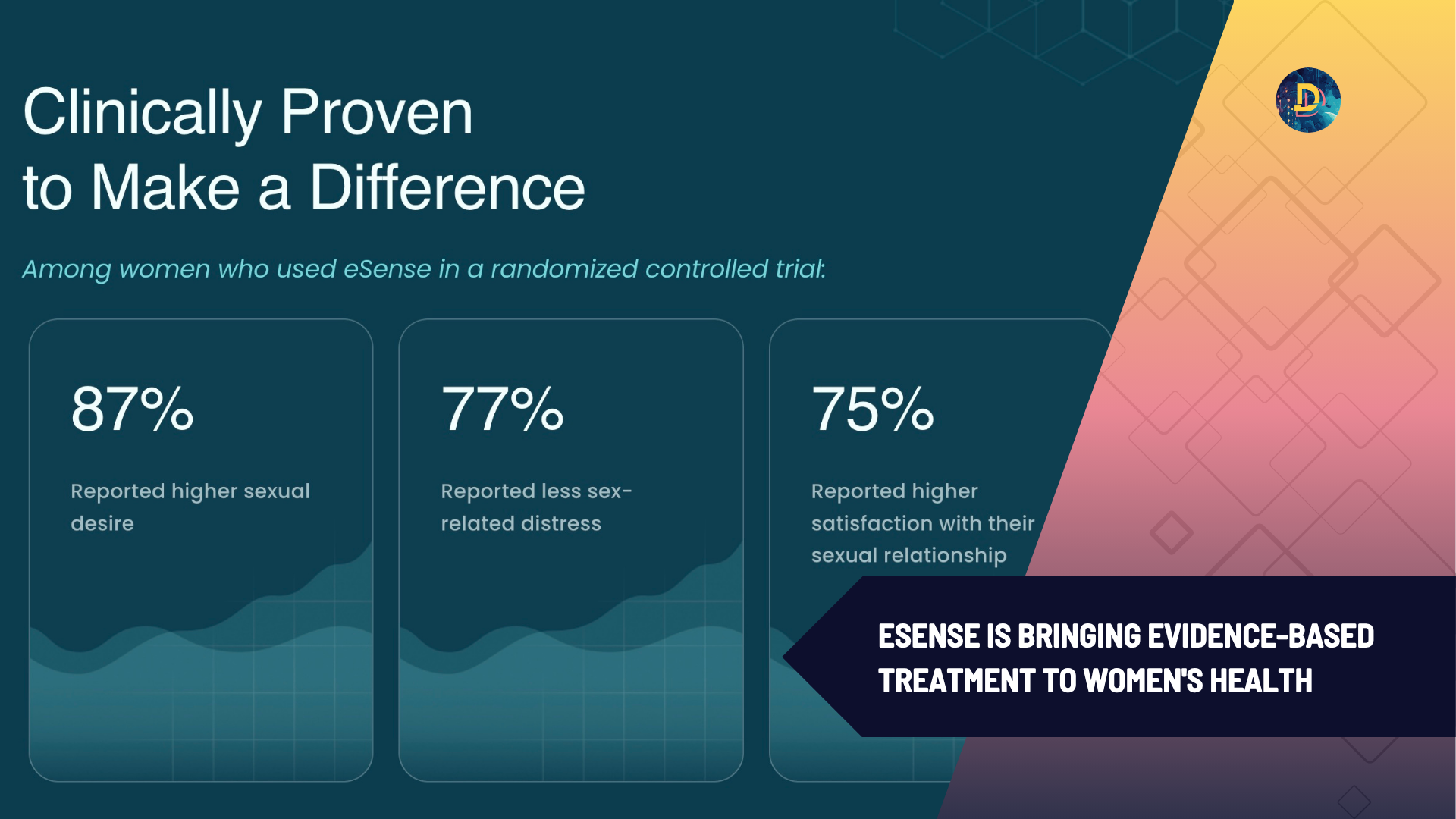
In that study, 87% of participants experienced an increase in sexual desire, 77% experienced less sex-related distress, and 75% reported improved sexual relationship satisfaction, with outcomes comparable to in-person psychological treatment.
After years spent establishing the scientific evidence and building the platform, the company has moved to its next challenge: commercialization.
From Clinical Validation to Commercial Validation
In April, eSense launched a limited commercial pilot to answer a different set of questions: Will women pay for this type of treatment? How will they discover it? And can healthcare providers become an effective channel for reaching women who need help?
The early results are encouraging.
Approximately 250 women have started a trial, roughly 100 have become paying customers, and the company has generated more than $30,000 in pilot revenue—all without paid marketing. Overall trial-to-paid conversion is approximately 43%.
But the pilot has also shown eSense where the commercial model still needs work.
Healthcare providers have responded positively to having an evidence-based psychological option they can offer patients. Turning that interest into a consistent referral process, however, isn't as simple as handing every clinic the same referral code.
Different healthcare settings introduce eSense to patients in different ways. The company's early tracking systems haven't always captured those referrals either: users have reported hundreds of referrals to eSense that aren't fully reflected in the company's attribution data.
Rather than treating that as a failure of provider interest, eSense is using the pilot to redesign the process—developing clinic-specific landing pages, improving referral tracking and learning how eSense fits into different clinical workflows.
The question is evolving from “Will anyone pay for this?” to “How do we make customer acquisition repeatable and scalable?”
Why eSense Isn't Just Another App
In one investor conversation, Brotto was asked a question that is becoming increasingly common in digital health: couldn't an AI chatbot provide something similar?
For Brotto, the question highlighted an important distinction.
eSense isn't a collection of general sexual-health information or AI-generated advice. It delivers a structured therapeutic protocol that has been developed through years of research and subjected to clinical evaluation.
AI may ultimately have a role in how digital healthcare is delivered, but providing information and delivering a validated therapeutic intervention are not the same thing.
Making that distinction clear has become increasingly important as consumers encounter an expanding universe of wellness apps, chatbots and digital health products.
Science Meets Commercial Experience
eSense is also evolving beyond its academic roots.
Dr.’s Brotto and Stephenson remain central to the company’s scientific and clinical foundation, while CEO Elayne Wandler, an experienced life-sciences and healthcare commercialization executive, leads the company’s business strategy.
The company is intentionally building a lean commercial organization around that combination of scientific authority and commercialization experience as it works through its pilot.
That matters because eSense isn’t trying to prove the research all over again. The challenge now is getting an evidence-based treatment into the hands of significantly more women.
Why We're Watching
Dr. Brotto came to entrepreneurship through an unusual route.
After years of conducting and publishing research, one realization became increasingly difficult to ignore: publishing evidence that a treatment works doesn't necessarily make that treatment accessible to the women who need it.
eSense is an attempt to close that last mile.
The science has been validated. The platform has been built. And early commercial results indicate women are willing to pay for accessible, evidence-based sexual healthcare.
What eSense still needs to demonstrate is that it can turn those early signals into an efficient and repeatable commercial model.
If it can, the company has an opportunity to make an area of women's healthcare that has remained difficult to access—and even harder to talk about—available to a much broader population.